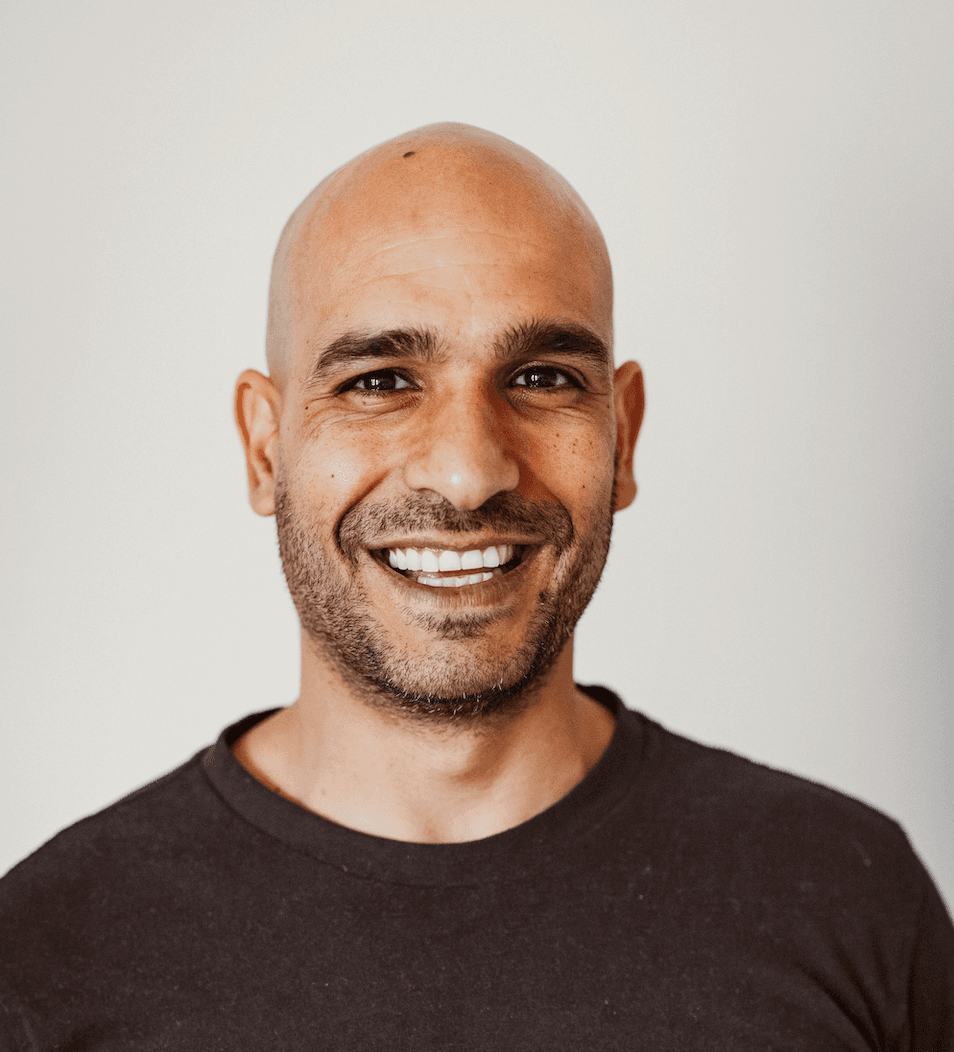
Shai Shalom Hadad's method for acquiring English

Inputhomeworka chapterfeedback, once a termOutputspeaking · grammar · testsInputlistening · reading · exposureOutputFeedback

What sits at the center? Flip the angle and every question that had no answer suddenly has one.

So why hasn't it happened yet?

Twelve years of school. A course or two. You understand almost everything, and in front of people you freeze. That's not a bug in you. It's the model.

the coursethe day aftera few weeks lateryour English
  • Textbook English

    School gave you a fair amount of input, mostly written. What you never got there: chances to produce and get a response. Years of half a cycle. The proof: what you remember from it is grammar rules and reading-comprehension tests, exactly the things nobody asks you for in real life.

  • The course trap

    In the middle of a course you swim in input and feel yourself improving. Because you are improving. The trouble starts the day after, when there's no classroom and you're back to a life where 99 percent of the day happens in Hebrew. Not because the course was bad. Because it was temporary.

  • A gym, not a bicycle

    You learn a bicycle once and your body remembers. A muscle you stop training gets weaker, no matter how strong it was. A second language is a muscle. So is your Hebrew, by the way. You just train it all day without noticing.

The method

You don't need a new method. You need the one that already worked for you once. Here are its parts, one at a time.

How did you learn Hebrew?

A year or two went by before a single meaningful word came out of you. Mom talking, dad rambling, the TV in the background. Nobody sat you down at eighteen months and explained what a noun is. An enormous amount of input piled up, and one day a brain that had spotted enough patterns produced a word. With English we did the exact opposite: output first, please, and quickly.

Listening
Speaking
Reading
Writing
Grammar
Never. And it works.
age
birth1234567
InputOutputFeedback

The acquisition cycle

That's how every language is acquired, and it's how your English will be too. You don't need to follow grammar. You need to grow this cycle: in volume, in difficulty, in quality.

Input
Everything that comes in: reading, listening, exposure. The vast majority of the cycle, and the part everyone skips.
Output
What comes out: speaking and writing. The proof that input landed, not the goal you train toward.
Feedback
The response from your surroundings that corrects the brain. Not a mid-sentence correction. A gentle echo of what you said, the right way.

Why "just speak more" doesn't work

If you only speak and there's no feedback correcting how your brain handles a word, it doesn't matter how many times you say it. It won't settle correctly. You always need input. Call it the source of truth.

The language pie

You sleep 8 hours. That leaves 16 hours of language. Cut them into 20-minute chunks and you get 48. Be honest: for most Israelis, one chunk is in English, maybe two. The question isn't how long to "study". The question is which chunks already exist and can be swapped.

  • Hebrew
  • English today
  • Chunks you swapped
1
chunk = 20 minutes

Which chunks are you willing to swap to English?

Today
1 of 48
After the swaps
1 of 48

This runs in your browser. Nothing is saved or sent anywhere.

English anchors

Not "when I get to it". Always. The more anchors you have, the more the pie changes without you deciding again every morning. And that's the whole point: a chunk that needs a decision won't happen. A chunk that happens by itself happens every day.

One of my biggest anchors is a friend I've spoken English with for more than 20 years. At 17 I simply asked him: can we talk in English? To this day we both speak English with our kids too.
  • A person

    A friend, a colleague, a cousin. You speak English with them even if their Hebrew is perfect.

  • An activity

    The commute podcast. The evening series. The lunchtime chat with an AI. It doesn't move.

  • A habit

    Your phone in English. The news in English. The grocery list in English. Small, fixed, compounding.

The toolbox

A sense of rhythm, a musical ear, structural thinking, consistency, curiosity, mimicry, or simply no fear of mistakes. Think about yourself in Hebrew: how do you argue, tell a story, make people laugh, close a deal? Those are the tools that carry over to English. Which is why "how long will it take" is the wrong question. The question is which tools you're working with.

Rhythm82%
Musical ear64%
Structure38%
Consistency90%
Curiosity72%
Mimicry55%
No fear of mistakes30%
One example tuning. None of these sliders is static: all of them move with more exposure and more practice.

The exposure formula

That's how you built every bit of knowledge you have in Hebrew: you multiplied your meetings with the idea instead of seeing it once and letting it fade. English works exactly the same way.

  1. FrequencyHow often you run into it
  2. VarietyDifferent contexts, speakers, situations
  3. InterestDoes your brain want to remember it?
  4. RelevanceWill you need to use it?
  5. ComplexityHow many sub-patterns are inside

Comprehensible input

English slightly above your level. Not too easy, not too hard. And about something that genuinely interests you, not "interesting" the way an exam passage is. Curiosity beats the fear of reading something in English.

And what changed now

All these years the real problem wasn't motivation. It was supply. Where do you find an English text, on a topic you actually care about, slightly above your level, at eight in the evening after the kids fell asleep? Today you can generate personalized input on any topic, practically for free, and get output and feedback on it in the same window.

AI is not a shortcut. It doesn't replace anything in the method. It just makes it possible.

Four questions for any new tool someone shows you

  1. 1.Does it give me comprehensible input, slightly above my level and about something I care about?
  2. 2.Does it close the cycle, meaning output and feedback too, not just consumption?
  3. 3.Does it swap a chunk in my pie, or ask me for more time I don't have?
  4. 4.Can it be an anchor, meaning it happens even in the week I'm not into it?

Who this is for

  • You understand almost everything, and in front of people you get stuck.
  • Twelve years of school, a course or two, and you ended up back where you started.
  • On Zoom you're "fine". In a hallway chat with a colleague from the US you choke.
  • In Hebrew you're the sharpest person in the room. In English you drop two levels.
  • You're not looking for another course. You want to understand why it didn't work.

Who it's not for: anyone looking for "fluent in three weeks". There's no such thing, and whoever sells it to you is selling a dream.

Shai Shalom Hadad
  • Jerusalem
  • Zero English at home
  • 12+ years coaching
  • Founder of PRIME

The story

I get asked this all the time. No. Shai Shalom Hadad, Yemenite-Israeli, raised in Jerusalem. My parents didn't speak English at home. My father barely speaks it to this day.

There was TV. There was Danny, a kid from New Jersey who landed in our fourth-grade class, and I was the first to raise my hand to show him around. There were four summers at a Jewish camp in America. And there was the music of the Yemenite synagogue, which somehow tuned my ear before I knew what an accent was.

Without knowing it, I was applying exactly what's on this page: a lot of input, early, from varied sources, about things that fascinated me. Then output and feedback from real friends. Today I've been coaching communication and language for more than 12 years, and I'm the founder of PRIME.

I'm not an academic and I'm not an English teacher. I'm someone who did it himself, understands why it worked, and wants to explain it to Israelis at eye level.

What's coming

The ideas on this page are the foundation. Here's what's being built on it now, in the order it ships.

  • Ships with the book

    The prompt library

    The prompts from the AI appendix: personalized input, a language-pie audit, a conversation partner, and gentle feedback without the red pen. Copy, paste, begin.

  • In development

    Anchor

    A personal AI English coach built on the method: input before output, chunks instead of "study time", and an anchor that shows up every day in the same voice.

Waitlist

Leave your email. When the book ships, you get one message from me. That's it.

Email me and I'll add you to the list

No spam. No weekly newsletter. One email when it's out.